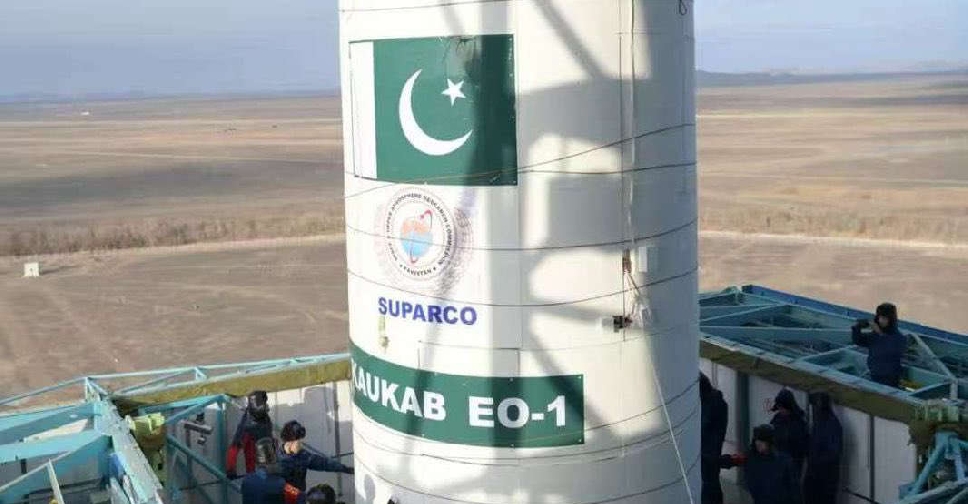
Pakistan launched its first home-made observation satellite on Friday from the Jiuquan Satellite Launch Centre in northern China.
The PRSC-EO1 satellite will boost Pakistan's ability to monitor and manage natural resources, respond to disasters, and improve urban planning and agricultural development, the Space and Upper Atmosphere Research Commission (SUPARCO) said in a statement.
This type of satellite uses electro-optical sensors to collect data and images of the Earth's surface by detecting and measuring reflected sunlight or emitted radiation.
China's Long March-2D carrier rocket also launched on Friday two other satellites, Tianlu-1 and Blue Carbon 1, into orbit along with the PRSC EO1, China Aerospace Science and Technology Corporation said.
"Spearheaded by SUPARCO, this demonstrates our nation's growing capabilities in space science and technology," said Prime Minister Shehbaz Sharif.
Currently valued at $5 billion, the earth observation satellite market is among the fastest growing sectors within the commercial space industry, with Novaspace predicting it to exceed $8 billion by 2033.
Countries including the United States, China and India have been building their own government and private satellite constellations to map the Earth. Indian startup Pixxel this month launched the country's first privately built satellite constellation.

 Philippines confirms visit by alleged Bondi gunmen amid terrorism concerns
 Israeli forces kill Palestinian teen in West Bank, health ministry says
 Trump sues BBC for defamation, seeks up to $10 billion in damages
 FBI foils 'terror plot' targeting Los Angeles
 Hong Kong court finds tycoon Jimmy Lai guilty in landmark security trial